
TL;DR
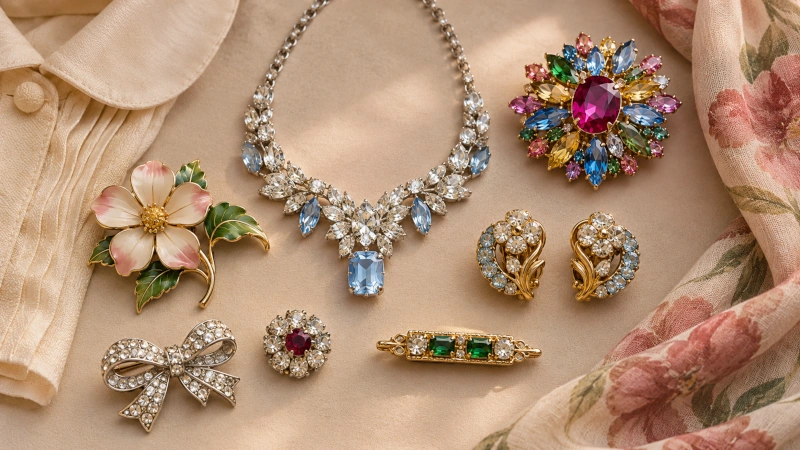
Vintage jewellery does not have to be expensive, rare or kept in a box for special occasions. Brooches, rhinestone pieces, necklaces, earrings and bracelets can all add a bit of colour and personality to everyday clothes.
Start by buying pieces you genuinely like, check clasps, stones and settings carefully, and do not worry too much about collecting famous makers when you are beginning. A beautiful unsigned brooch can be just as enjoyable to wear as a recognised designer piece.
Most importantly, vintage jewellery was made to be worn. A brooch on a jacket, a sparkling necklace with a simple top or a pair of colourful earrings can bring a little vintage character into an otherwise modern wardrobe.
Vintage jewellery has an advantage over many other collectables: you can actually take it with you.
A colourful brooch does not need a display cabinet. A rhinestone necklace does not have to wait for a formal dinner. And those bright clip-on earrings that look a little too dramatic sitting in a jewellery box can suddenly make perfect sense with a simple black top.
For someone new to vintage jewellery, though, the sheer variety can be confusing. There are brooches, dress clips, rhinestones, faux pearls, enamel pieces, costume jewellery, sterling silver and unsigned pieces alongside jewellery carrying well-known maker’s names.
The good news is that you do not need to become an expert before you start enjoying it.
A basic understanding of what you are looking at, a few condition checks and a willingness to wear what you buy will take you a long way.
Costume Jewellery Isn’t a Second-Rate Option
The term costume jewellery sometimes sounds as though it describes jewellery pretending to be something better. In reality, costume jewellery has a long history of being fashionable, creative and deliberately affordable.
Rather than relying on precious stones and solid gold, makers used materials such as glass stones, rhinestones, enamel, plated metals, imitation pearls and plastics to create jewellery that followed the fashions of the day.
That freedom often produced wonderfully bold pieces. Flowers could be oversized, colours brighter and designs more playful than traditional fine jewellery.
Today, those same qualities make vintage costume jewellery appealing to collectors. You can find everything from elegant pieces that imitate diamonds and pearls to wonderfully kitschy brooches shaped like animals, flowers, leaves and even everyday objects.
And because many unsigned pieces remain affordable, it is an area where you can still collect primarily because you like something rather than because a price guide tells you that you should.
Why Brooches Are a Great Place to Start
Brooches may be one of the easiest ways into vintage jewellery.
They come in almost every style imaginable, they are generally easy to store and display, and they can completely change the look of an outfit without requiring much effort.
Vintage brooches can be delicate sprays of rhinestones, enamel flowers, abstract modernist shapes, little animals, leaves, bows or large colourful statement pieces. Some are subtle enough to sit quietly on a jacket lapel, while others are clearly designed to get noticed from across the room.
They are also wonderfully flexible.
A brooch can be pinned to a jacket, cardigan, scarf, hat or fabric handbag. A small cluster of brooches can work together on a denim jacket, while one dramatic piece may be all that is needed on a plain coat.
If you have inherited a brooch that feels a bit too formal for your usual clothes, try it somewhere unexpected. A sparkling 1950s-style piece on denim can feel much more relaxed than the same brooch on an evening dress.
That contrast between old and new is often what makes vintage jewellery work best today.
Rhinestones: Plenty of Sparkle Without the Diamonds
Rhinestones are one of the defining materials of vintage costume jewellery.
At their simplest, they are faceted stones made to imitate the sparkle of precious gems. Most vintage examples are glass, although other materials have also been used over the years.
The appeal is easy to understand. Rhinestones can transform an inexpensive metal setting into something glamorous and eye-catching.
Clear rhinestones give the classic diamond-like look, but coloured stones are where things can become especially interesting. Deep greens, ruby reds, blues, pinks and aurora-style finishes can turn a brooch or necklace into a miniature colour display.
When looking at a rhinestone piece, check whether all the stones are present and whether they appear reasonably secure. One missing stone in a complicated design may be difficult to notice at first but surprisingly obvious once you know it is there.
Also look for stones that have darkened or become cloudy. Sometimes this is surface dirt, but older foil-backed stones can deteriorate from behind, creating dark spots that cleaning will not remove.
That does not necessarily make the piece unwearable. A little age may be completely acceptable, especially on an inexpensive piece. Just make sure the condition matches the price.
Signed and Unsigned Jewellery
Turn over enough vintage jewellery and sooner or later you will start looking for names.
Some pieces are clearly marked by their maker. Others carry a small symbol, country of origin or metal mark. Plenty have nothing at all.
For new collectors, it is easy to fall into the trap of assuming that signed automatically means valuable and unsigned automatically means ordinary. It is not that simple.
A maker’s mark can certainly help identify a piece and may increase collector interest, particularly if the brand is sought after. But many attractive and well-made pieces were never signed, or were originally sold with paper tags that disappeared decades ago.
When you are starting out, it is often better to judge the jewellery in front of you first.
Is the design appealing? Does it feel well made? Are the stones neatly set? Does the clasp work properly? Would you actually wear it?
If the answer to those questions is yes, the absence of a famous name does not have to matter.
You can always learn makers and marks as your interest grows.
What to Check Before You Buy
Condition is particularly important with jewellery because everything is small and the working parts matter.
With a brooch, turn it over and test the pin carefully. It should open and close without excessive force, and the clasp should hold the pin securely. Check that the pin itself is reasonably straight and firmly attached.
For necklaces and bracelets, test the clasp and look at the links around it. These areas receive plenty of wear and are often where problems first appear.
With clip-on earrings, make sure both clips still have enough tension to stay in place. Screw-back earrings should turn freely without feeling stripped or jammed.
Then inspect the decorative side.
Look for missing rhinestones, loose settings, badly chipped enamel, broken parts and obvious repairs. A little plating wear on an older piece may not bother you at all, particularly if it is on the back. Heavy corrosion, green residue or structural damage deserves more caution.
You do not need perfection. You simply want to know what you are buying.
A small flaw at a good price can be perfectly acceptable. Discovering the same flaw after paying a premium is far less enjoyable.
Where to Find Vintage Jewellery
One of the pleasures of vintage jewellery is that it can turn up almost anywhere.
Thrift and charity shops can still produce inexpensive surprises, although jewellery displays vary enormously from store to store. Flea markets, antique centres, estate sales and vintage fairs are excellent places to browse because you can usually handle pieces and examine clasps, backs and stones closely.
Markets can be particularly good when sellers have boxes or trays of mixed jewellery. Taking a few minutes to look through them carefully can uncover pieces that are easy to overlook at first glance.
Online marketplaces and auction sites offer far more choice, especially when you are searching for a particular style or maker. The trade-off is that you cannot hold the jewellery before buying it.
For online purchases, photographs of the back are almost as important as photographs of the front. The reverse can show the construction, clasp, marks, repairs and condition much more clearly.
If a listing shows only one glamorous front-facing photograph, it is worth asking for more.
Everyday Wear: You Don’t Need a Vintage Outfit
One of the easiest ways to make vintage jewellery feel dated is to think that you need to wear it with an entire vintage outfit.
You don’t.
In fact, vintage jewellery often looks better when it is the one old element in an otherwise modern outfit.
A rhinestone brooch on a plain blazer can add interest without looking formal. A colourful enamel brooch works beautifully with denim. A simple vintage necklace can sit over a plain T-shirt or knit. Clip-on earrings can bring colour to an outfit that otherwise has very little going on.
The idea is to let the jewellery do some of the work.
If the piece is large, colourful or sparkly, keep the rest relatively simple. If the jewellery is smaller and quieter, you can comfortably layer it with other pieces.
There are no strict rules. If you like the way it looks, that counts for more than whether it perfectly matches the decade it came from.
Brooches Don’t Have to Stay on Lapels
Brooches deserve a little experimentation.
A scarf is an obvious alternative to a jacket, especially if the fabric is sturdy enough to handle the pin. Hats can work beautifully too.
Fabric handbags can be another option, although it is worth checking that the pin will not permanently damage the material.
You can also group small brooches together. Three little floral brooches can create more impact as a cluster than each would individually. Animal brooches can be arranged almost like a miniature collection on a denim jacket or coat.
Just remember that brooch pins make holes. Delicate fabrics, fine knits, leather and some modern technical materials may not appreciate being pierced.
When in doubt, choose something sturdier.
Cleaning Vintage Jewellery: Less Is More
Vintage jewellery can be much less forgiving of cleaning than a plain glass vase or ceramic bowl.
Water can work its way behind rhinestones and damage foil backing. Strong cleaners can remove plating, affect enamel or attack adhesives. Pearls — including imitation ones — can also have delicate surface coatings.
For most pieces, start with a soft dry cloth and a gentle brush to remove dust. A cotton bud can help reach small areas around settings.
If more cleaning is needed, identify the materials first and proceed carefully. Avoid automatically soaking costume jewellery, even if it looks sturdy.
Rhinestone pieces in particular are best treated cautiously. Getting them sparkling is satisfying, but preserving the original stones and settings is more important than chasing a showroom-new finish.
Vintage jewellery has already survived decades. Gentle treatment gives it the best chance of surviving a few more.
Storing Your Collection
A tangled jewellery box is not the ideal retirement home for vintage pieces.
Necklaces should be stored so chains do not knot together. Brooches benefit from individual compartments or padded trays so pins and stones do not rub against neighbouring pieces. Earrings are much easier to enjoy when pairs remain together.
Soft pouches can work for some jewellery, but avoid putting multiple pieces in the same pouch where they may scratch each other.
Humidity is another consideration. Jewellery generally prefers a dry environment, particularly pieces made from plated or base metals.
And if you enjoy looking at your collection, there is nothing wrong with displaying some of it. A padded brooch board, jewellery stand or shallow glass-topped case can turn pieces into decoration while keeping them accessible.
After all, there is not much point owning jewellery you forget you have.
Collect What Makes You Smile
It is easy for any collecting hobby to become focused on rarity, makers and value.
Those things can certainly be interesting, but they do not have to be the starting point.
Maybe you like floral brooches. Perhaps you always notice green rhinestones. You might collect cats, birds, butterflies or jewellery from a particular decade. Or you may simply buy anything that makes you stop and take a second look.
Those preferences are what eventually give a collection personality.
You may discover along the way that one of your inexpensive finds happens to be by a desirable maker. That is a nice bonus. But a ten-dollar brooch that you wear constantly can be a much better purchase than a valuable piece that stays permanently in a drawer.
Final Thoughts: Wear the Good Stuff
Vintage jewellery is one of those collecting areas where enjoyment does not have to stop once you make the purchase.
Wear the brooch. Put on the rhinestones. Try the oversized earrings.
You do not need a special occasion, and you certainly do not need an entirely vintage wardrobe.
Start with pieces that appeal to you, learn to recognise reasonable quality and condition, and gradually work out which styles you actually enjoy wearing. Some finds will turn out to be favourites; others may eventually be passed along to someone else.
That is all part of collecting.
The best vintage jewellery does more than sit in a box reminding you of another era. It becomes part of what you wear today — with just enough sparkle, colour or kitsch to make things more interesting.
Leave a Reply