
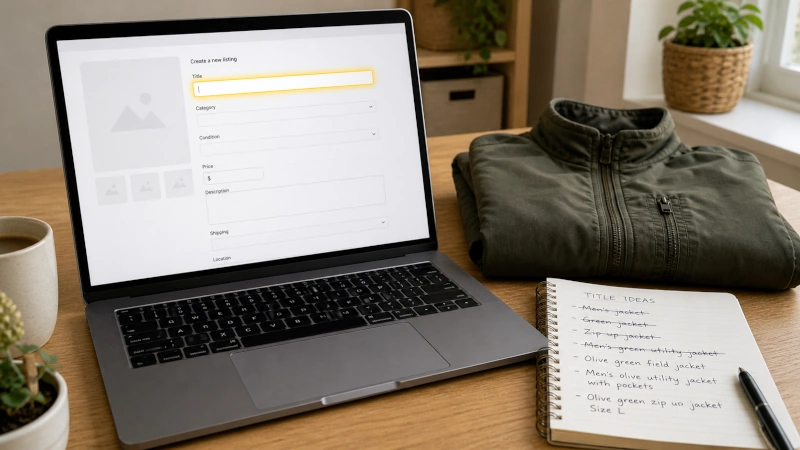
TL;DR
Your title is one of the biggest factors in whether a buyer finds your listing in the first place. A strong eBay title should be clear, specific and packed with useful search terms, not filler. The goal is not to sound clever. It is to help the right buyer find the right item quickly.
Why Titles Matter So Much on eBay
On eBay, the title is doing two jobs at once. First, it helps the search system understand what you are selling. Second, it helps a buyer decide whether your listing looks relevant enough to click on.
That is why titles matter so much. Even if your photos are excellent, buyers still need to find the listing before those photos can do their work. eBay’s Seller Center says its system matches buyer searches closely to listing titles, and it specifically encourages sellers to use the available 80 characters well.
A good title does not try to impress everyone. It tries to match the words a real buyer would type when they already know roughly what they want.
The Goal of an eBay Title
A good eBay title should tell the buyer exactly what the item is as quickly as possible. In most cases, that means using plain, searchable words rather than trying to write a sentence.
eBay’s current seller guidance says you have 80 characters to work with and recommends using as many of them as you can in a useful way. It also suggests including details such as brand, model or type, color, style, and model number where relevant, and avoiding special characters or irrelevant words.
That gives you a simple target: fill the space with words that help search and help the buyer, and leave out words that do neither.
How Buyers Actually Search
Most buyers do not search eBay in polished sentences. They usually type a short string of keywords: brand, item type, size, colour, model, material, era, or condition. They are trying to narrow down the options quickly.
That means your title should sound more like a focused label than a sales pitch. Think about how someone would search if they were trying to find your exact item in a hurry. What are the first words they would use? What details would help them tell your listing apart from ten similar ones?
If you can answer that clearly, you are already writing better titles than many sellers.
A Simple Title Formula That Works
For most items, a simple structure works well:
Brand + Item Type + Key Feature + Size/Model/Colour + Useful Extra Detail
Not every title needs every element, and the order can change depending on the item, but this structure gives you a reliable starting point. It keeps the most important words in the title while still leaving room for details that help the item appear in relevant searches.
For example, a vague title like:
Nice blue jacket
could become:
Nike Men’s Blue Zip Jacket Size L Lightweight Running
The second title is not flashy, but it is much more useful. It tells both eBay and the buyer what the item actually is.
Put the Most Important Words First
The beginning of the title matters most because it is seen first in search results and on smaller screens. If a buyer only scans the first part of the title, they should still understand the basics of what you are selling.
That usually means leading with the brand or the clearest item description, not filler. If the brand matters, use it early. If the brand does not matter but the object itself does, lead with the object.
A title that begins with “Beautiful” or “Look” or “Wow” wastes valuable space. eBay’s guidance specifically advises against irrelevant words and recommends stating exactly what the item is.
What to Include in the Title
The best title details are the ones buyers are likely to search for. Depending on the item, that can include the brand, product type, model, size, colour, style, material, pattern, era, or an identifying number.
eBay also recommends using correct spelling and adding relevant item attributes in your listing, and its Seller Center examples specifically mention brand, model or type, color, style, and model number where relevant.
The key word here is relevant. Do not force in details that do not matter. Add the things that would genuinely help a buyer recognise your item or find it more easily.
What to Leave Out
A lot of weak eBay titles are not weak because they are too short. They are weak because they are full of words that do not help.
Words like “wow”, “look”, “rare!!!”, “must see”, “amazing”, and similar filler usually do not help buyers find the item. They take up space that could be used for actual search terms. eBay’s older Best Match guidance explicitly warns against irrelevant words and says to omit punctuation marks and asterisks. Its newer Seller Center guidance also says to avoid special characters and irrelevant words.
The same goes for repeating the same keyword too many times. If your title starts sounding unnatural, cluttered or desperate, it is probably time to simplify it.
What Keyword Stuffing Looks Like
Keyword stuffing happens when a seller tries to cram in every remotely related word, hoping one of them will catch a search. The result is usually messy and harder for both buyers and the search system to understand.
A stuffed title might look something like this:
Vintage Retro MCM Mid Century Modern Glass Vase Decor Home Art Collectible Rare
There are a lot of keywords there, but the title still does not clearly say what the actual item is. It feels broad, repetitive and vague.
A better version would be something like:
Vintage Green Glass Vase Mid Century Modern Ribbed 25cm
That title is clearer, easier to scan, and far more helpful. It still uses searchable terms, but it describes one actual item rather than throwing a pile of buzzwords at the page.
Clear Beats Clever
One of the easiest mistakes for new sellers is trying to make a title sound stylish rather than useful. On a blog post or social media caption, clever wording can work. On eBay, it often gets in the way.
A title is not the place for mystery. Buyers should not need to decode what you mean. If the item is a ceramic bowl, say ceramic bowl. If it is a men’s leather belt, say men’s leather belt. If it is a Sony CD Walkman, say Sony CD Walkman.
The clearer your title is, the easier it is for the right person to find it and click.
Use the Full 80 Characters, But Do It Wisely
There is no prize for writing the shortest title possible. If extra words make the title more searchable and more accurate, use them. eBay’s Seller Center says you have 80 characters and encourages sellers to use as many as they can in a useful way.
That said, more is not automatically better. The aim is not to hit 80 characters for the sake of it. The aim is to use the space for relevant information. If your title is already clear and complete at 62 characters, forcing in random extra words usually makes it worse, not better.
Good Titles and Better Titles
It helps to think in pairs.
Too vague:
Canon Camera
Better:
Canon EOS 600D DSLR Camera Body Black
Too vague:
Vintage Plate
Better:
Vintage Floral Dinner Plate Porcelain Gold Trim 27cm
Too vague:
Leather Boots
Better:
RM Williams Men’s Brown Leather Boots Size 10 Chelsea
The stronger examples do not rely on hype. They simply add the details that a buyer would actually care about when searching.
Titles and Item Specifics Should Work Together
Your title does not need to carry every last detail by itself. eBay also uses item specifics, categories and product details to help match listings to buyers, and its guidance encourages sellers to provide as many relevant details as possible.
That means the title should do the heavy lifting, but it does not need to do all the lifting. Use the title for the strongest search terms, then let item specifics handle the rest. This also keeps titles cleaner and easier to read.
That is one reason keyword stuffing backfires. Sellers often try to jam title space with details that would be better handled elsewhere in the listing.
A Practical Way to Write Better Titles
A simple method is to write the title in stages.
Start by naming the item as plainly as possible. Then add the brand if it matters. Then add the most useful identifying details, such as size, model, colour, or material. Finally, read the title back and cut anything that feels vague, repetitive or decorative.
This approach works well because it forces you to build from the core outward. You start with what the item is, then add what helps the buyer identify it faster.
If you are ever unsure whether a word deserves to stay, ask one question: would a buyer realistically search for this? If not, it may not need to be there.
Common Title Mistakes
A lot of title problems come down to the same handful of habits. Spelling errors can make the listing harder to find. Leading with filler wastes valuable space. Overusing symbols can make the title look messy. Missing the brand, size or model can leave the listing too vague. And stuffing in too many barely related keywords can make the whole thing harder to read.
eBay’s guidance specifically recommends correct spelling, clear and concise titles, no more than 80 characters, and avoiding special characters or irrelevant words.
Most of these mistakes are easy to fix once you know what to look for.
Titles Get Easier With Repetition
Like photos, titles become easier once you develop a repeatable system. If you sell regularly in the same kinds of categories, you will start to notice patterns in the details that matter most. Clothing titles often need brand, gender, item type, size and colour. Electronics often benefit from brand, model, storage size or part number. Homewares might need material, colour, size and style.
Once you spot those patterns, title writing gets faster. You stop guessing and start following a structure that fits the item.
That is usually the point where listings start to feel easier to create and more consistent across your store.
Final Thoughts
A strong eBay title is not about sounding clever or squeezing in every possible buzzword. It is about helping the buyer find the listing and immediately understand what is being offered.
Use the 80 characters well. Lead with the important words. Include the details buyers actually search for. Leave out filler, clutter and hype. And remember that a clean, accurate title nearly always beats a noisy one.
If your listing is not getting found, the title is one of the first things worth improving.
Leave a Reply