
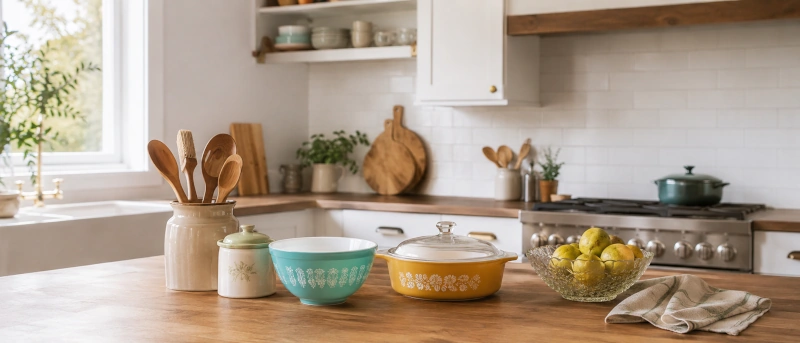
TL;DR
- Vintage kitchenware can still earn its keep, not just sit on a shelf looking pretty.
- Pyrex, mixing bowls, casseroles, tins and sturdy everyday pieces work best when you choose items that suit how you actually cook and live now.
- The goal is not to turn your kitchen into a museum. It is to mix useful vintage with modern basics so the space feels warm, personal and practical.
There is a particular charm to vintage kitchenware that newer pieces often struggle to match. It might be the colour of an old mixing bowl, the sturdiness of a casserole dish, or the way a familiar floral pattern makes a shelf feel instantly lived in. Vintage kitchen pieces have warmth. They look like they have already been part of someone’s daily routine, and that history is part of the appeal.
Pyrex is often the gateway. One dish becomes two, then a mixing bowl, then perhaps a patterned casserole or a simple lidded piece that somehow makes the whole kitchen feel more interesting. Before long, you realise Pyrex is only part of the story. There are also old stoneware jars, enamel tins, pressed glass storage pieces, ceramic canisters, pudding bowls and all the other practical “friends” that make a kitchen feel collected rather than flat-packed.
The good news is that vintage kitchenware can still work beautifully in a modern home. The trick is not to recreate a perfect period kitchen. It is to blend useful older pieces with the way people actually cook, store and live today.
Why Vintage Kitchenware Still Works
One reason vintage kitchenware remains so popular is simple: much of it was made to be used. These were working objects, not purely decorative ones. Mixing bowls were meant to be lifted and scraped clean. Casserole dishes were made to go from preparation to table. Canisters, jars and storage tins were there to make kitchens more orderly and more pleasant to live with.
That practicality still matters. In fact, it may be the biggest reason vintage kitchen pieces fit so naturally into modern kitchens. Even when your appliances, benchtops and cabinets are new, an older bowl or dish can still pull its weight.
There is also the visual side. Vintage pieces soften a kitchen. They add colour, pattern and texture in a room that can otherwise become a sea of hard surfaces. Glass, ceramics and enamel all bring a different kind of character from the sleek finishes of most modern kitchens. A few well-chosen vintage pieces can make the whole room feel more human.
Why Pyrex Holds Such a Strong Appeal
Pyrex gets a lot of attention because it sits at the sweet spot between usefulness and nostalgia. It is recognisable, often colourful, and easy to imagine in daily life. Some people love the clear simplicity of older ovenware. Others are drawn to patterned casseroles, nesting bowls or pieces that remind them of family kitchens.
Part of the appeal is that Pyrex often looks cheerful without being fussy. It can add vintage character to a kitchen without feeling overly delicate or formal. It also pairs well with newer kitchens because its shapes are usually clean and practical.
But Pyrex is not the whole story, and it does not need to carry the full vintage look on its own. Some of the most inviting kitchens mix Pyrex with other useful older pieces: ceramic canisters, old measuring jugs, wooden utensils, pressed glass bowls, stoneware crocks and simple linens. That is where the “and friends” part really starts to matter.
What Counts as “Pyrex & Friends”?
Think of this topic as being less about one brand and more about a way of building a kitchen with personality.
Pyrex may be the star, but its supporting cast can include all sorts of practical vintage pieces. Mixing bowls are an obvious favourite, especially when they bring a bit of colour to open shelving or a benchtop corner. Casserole dishes and baking dishes work well because they are both useful and displayable. Canisters and storage jars bring order to tea, coffee, sugar, flour or utensils while making everyday storage feel a little more considered.
Then there are the smaller pieces that quietly do a lot of work. A ceramic spoon rest, a sturdy old jug used for flowers or utensils, a pressed glass bowl holding fruit, a tray for oils and condiments, or a vintage tin used to corral tea towels can all help tie a kitchen together. None of them need to be precious. In fact, they work best when they feel relaxed and at home.
The point is not to fill every corner with old things. It is to choose the pieces that genuinely make the kitchen nicer to use.
Start with the Kitchen You Actually Have
One of the easiest mistakes to make with vintage décor is buying for an imaginary house rather than the home you live in now. The same applies in the kitchen.
If you have a small kitchen, you probably do not need a huge collection of oversized casseroles unless you truly use them. If you have closed cupboards and very little bench space, you may want vintage pieces that can live inside cabinets but still make you happy when you take them out. If you have open shelving, then display value becomes more important.
It helps to ask a few honest questions. Do you want vintage kitchenware mainly for use, or mostly for atmosphere? Are you the kind of person who will happily bake in older dishes every week, or do you just want a few character pieces on display? Do you prefer a tidy kitchen with only a handful of visible items, or do you enjoy a more layered, lived-in look?
Once you know that, it becomes easier to buy well. The best vintage kitchen is not the one with the most pieces. It is the one where the older items genuinely suit the rhythm of your household.
Choosing Pieces That Pull Their Weight
The most successful vintage kitchen pieces tend to be the ones that do more than one job. A mixing bowl that looks lovely on a shelf but also gets used for baking is ideal. A casserole that can go from storage to serving to display earns its place. A lidded jar that holds dry goods while adding texture to the bench is exactly the kind of practical charm you want.
This is where restraint helps. Instead of buying ten pieces that are only vaguely useful, it is usually better to start with three or four that clearly belong in your daily life. A good bowl, a dish or two, a storage jar and perhaps one decorative-but-practical extra can already change the feel of a kitchen.
Condition matters too, especially in a room where things are handled often. Tiny signs of age can be part of the charm, but large chips, cracks or badly stained interiors may make a piece less enjoyable to use. In the kitchen, practicality counts. You want to feel pleased when you reach for a piece, not slightly worried every time.
Mixing Vintage with Modern Without Looking Theme-y
This is where many kitchens either sing or slide into costume.
A modern kitchen can absolutely handle vintage pieces, but balance is what makes it work. If everything is vintage-look, the room can start to feel staged. If everything is sleek and new, one lonely old bowl can look accidental. The sweet spot is somewhere in the middle.
Vintage pieces work well when they interrupt the modernity just enough. A stack of older bowls on a clean shelf. A floral casserole sitting among simple white dishes. A glass jar or ceramic canister softening a run of stone or laminate. Warm timber utensils next to modern appliances. These combinations feel natural because they give the eye some contrast.
Colour helps too. Many vintage kitchen pieces bring soft greens, creams, blues, yellows or warm earthy tones into a room. Those colours can be especially welcome if your kitchen leans heavily on white, grey, black or stainless steel. Even one or two older pieces can stop the space from feeling cold.
The important part is not to over-explain it. The kitchen should still feel like a working kitchen, not a retro display set.
Displaying Vintage Kitchenware So It Stays Useful
Vintage kitchenware looks best when it is displayed like it belongs there. That usually means keeping it close to where it would naturally be used.
Mixing bowls look right near the prep area. Canisters belong where you make tea, coffee or breakfast. A casserole or serving dish can sit on open shelving if it is easy to reach. A fruit bowl, jug or tray works well in the centre of the kitchen or on a side bench because it feels active, not decorative for decoration’s sake.
Open shelving can be wonderful for vintage kitchenware, but it does not need to be overloaded. A few strong pieces usually have more impact than a packed wall of collectibles. Leave room around them so their colour and shape can be appreciated.
If most of your storage is behind closed doors, you can still make vintage work beautifully. Choose a few pieces to live out in the open and let the rest be part of the pleasure of opening a cupboard and seeing something lovely waiting inside.
Caring for Older Kitchen Pieces
Older kitchenware deserves a little respect, especially if you plan to use it regularly.
In general, it is wise to avoid sudden temperature changes with vintage glass and ceramics. A piece that has lasted decades will often keep going happily with sensible handling, but it does not need to be shocked from cold to hot or vice versa. Gentle cleaning is also a good habit. Harsh scourers and aggressive scraping can leave marks or turn small flaws into larger ones.
For displayed pieces, dusting and occasional washing are usually enough. For working pieces, keep an eye on rims, bases and handles for any signs of wear that make them less comfortable or secure to use. A little age is part of the appeal; damage that makes you hesitate every time you lift something is another matter.
The nice thing about practical vintage is that it does not demand perfection. It just asks for a bit of common sense.
Building a Kitchen That Feels Collected
The best vintage-friendly kitchens rarely appear overnight. They grow piece by piece. A bowl from one place, a canister from another, a dish you could not leave behind because it looked exactly right. Over time, the kitchen starts to feel less like a room you assembled and more like a room you know.
That collected feeling is what many people are really after. Not a perfect matching set, and not a highly styled “look,” but a kitchen with layers. A place where older objects sit naturally alongside newer ones and make the room feel more settled.
Pyrex is often a lovely place to start, but the real magic comes from letting it mix with everything else that makes a kitchen feel lived in and useful.
Final Thoughts: Use the Pretty Things
Vintage kitchenware has a special talent for making ordinary moments feel slightly better. Mixing batter in an old bowl, setting out fruit in pressed glass, reaching for tea from a ceramic jar that has a bit of history behind it — these things add up. They make a kitchen feel warm, personal and used in the best sense of the word.
So if you are drawn to Pyrex and its many practical friends, there is no need to save them for special occasions or keep them hidden away. Start with a few pieces you genuinely enjoy looking at and using. Let them sit alongside your modern basics. Keep what works, pass on what does not, and let the kitchen grow into itself.
That is usually when vintage feels most at home: not when it is treated like a museum piece, but when it becomes part of the everyday rhythm of the room.
Leave a Reply