
TL;DR – Find something worth bringing home
- Try everyday descriptions as well as maker names and collecting terms.
- Treat “vintage”, “retro” and “rare” as starting points for research, rather than proof of age or value.
- Check measurements, condition, completeness and identifying marks before buying.
- Compare the complete cost and discuss packing for fragile pieces.
- Choose items you enjoy, and leave room in your budget for the next good find.
An amber glass vase, a patterned serving dish or a little ceramic ornament can change the feel of a shelf without changing the whole room. Part of the pleasure of buying vintage is discovering those individual pieces and imagining where they belong.
Vinted Australia offers another place to look. Alongside clothing, its categories include homewares, books, media and collectables. The interesting part is seeing what people have tucked away and are ready to pass on.
Finding something appealing is only the beginning. A few careful checks can help you decide whether it deserves a place in your home.
Search beyond the obvious words
A knowledgeable collector and someone clearing a cupboard may describe the same object very differently. One person might list a “mid-century amber glass vase”; another might simply write “yellow flower vase”.
Start with the name or style you know, then experiment with colour, material, shape and purpose. Try “pottery jug”, “glass bowl” or “orange kitchen canister” alongside more specific searches.
Browse nearby categories too, and save promising listings to your favourites. A broad search takes patience, but it can reveal pieces that a precise brand search misses. Avoid assuming that a vague description automatically means a valuable discovery.
Decide whether age or appearance matters most
People use “vintage” and “retro” loosely in marketplace listings. An older original and a recent piece inspired by an earlier style can look similar in a small photograph.
If you are decorating, you may be perfectly happy with a newer vase that has the right shape and colour. If you collect a particular maker or period, you will want stronger evidence before paying an original-piece price.
Decide which matters before browsing. This keeps you from buying a reproduction at a collector’s price simply because the listing uses a familiar decade or design term.
Look for evidence, not just a confident description
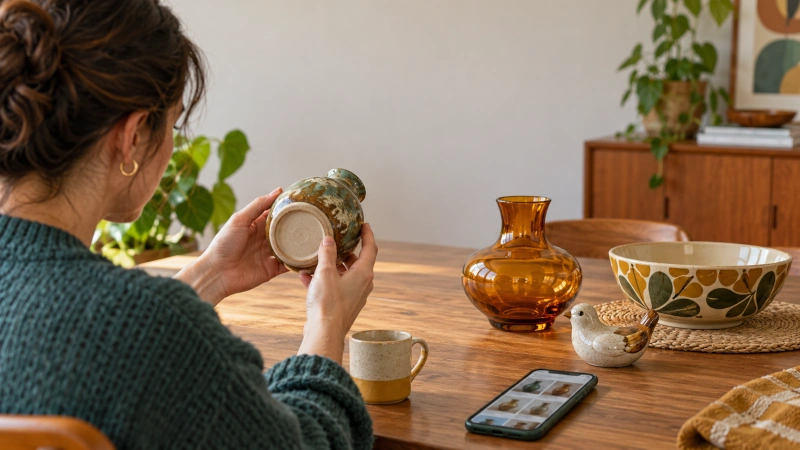
Ask for clear photographs of the base, labels, signatures and any moulded or impressed marks. Compare those details with reliable references, such as museum collections, maker archives, specialist books or established collector resources.
A mark may help identify a maker without establishing an exact date. Likewise, an unmarked piece is not automatically rare or valuable. Consider the whole object rather than relying on one detail.
Image searches can suggest possibilities, but similar-looking results are only clues. If attribution remains uncertain, judge the item as an attractive unidentified piece and set your budget accordingly.
Read condition in close-up
For glass, request views of the rim, base, handles and any narrow joins. Look for chips, cracks, cloudy patches and wear to painted or gilded decoration. Reflections can disguise damage, so ask about anything unclear.
For ceramics, inspect handles, spouts, lids and projecting decoration. Fine lines, discolouration and uneven areas deserve a closer look. Ask whether the seller knows of repairs rather than assuming that a neat surface means an untouched piece.
Wear can be part of an older object’s appeal. The question is whether you are comfortable with the particular fault, its effect on appearance and the price being asked.
Check size and completeness
Photographs are unreliable guides to scale. Ask for height, width and other useful dimensions, then compare them with the space where you plan to display the piece.
For sets, confirm the number of pieces and whether everything matches. Similar colours do not necessarily mean the same pattern, size or production period. A replacement lid might fit without being original.
Look closely at what is included. A display stand, decorative prop or neighbouring object in the photograph may not form part of the sale. Clarifying this beforehand is easier than sorting out different expectations later.
Judge value against comparable pieces
Compare items of similar size, condition, maker and completeness. Where possible, consult completed sales rather than relying entirely on asking prices.
An expensive listing that remains unsold does not establish market value. Neither does a seller’s “rare” description. Scarcity is only one consideration; demand and condition matter too.
Set a personal limit before making an offer. You might happily pay a little more for something that completes a set, but that is different from assuming every older object will increase in value. Buy for the enjoyment of owning it.
Count the full cost
Check the total including the Vinted fee and postage. A modestly priced object may still be worthwhile, but compare the delivered cost with alternatives.
At the time of writing, discounted postage is displayed alongside sellers’ asking prices. This can make smaller finds more appealing. Review the final checkout amount, as offers and rates may change.
Several items from one seller may suit a bundle purchase. However, fragile pieces need enough protective packaging, so ask about packing before combining them. A cheaper parcel is poor value if its contents cannot travel safely.
Ask how fragile pieces will be packed
For glass and ceramics, a friendly packing question is sensible. Ask whether the seller can use a sturdy box, wrap pieces separately and provide cushioning so they cannot move or touch.
Pay particular attention to handles, lids and projecting parts. A padded bag alone offers little protection against crushing for a delicate vase.
A seller may be new to posting fragile objects. If the proposed packing seems unsuitable, explain your concern before buying. It is reasonable to pass on something when you are not comfortable with the delivery arrangements.
Inspect before adding it to your collection
Keep payment and messages within Vinted. Its refund policy applies to qualifying purchases made through “Buy now”, subject to its terms.
When the parcel arrives, check the item against the listing before confirming acceptance. Vinted currently gives buyers two calendar days from its delivery or lost-order notification to report an issue through the order. Retain the packaging and photograph any damage.
Once you are satisfied, find the piece a home. A useful collection can grow slowly: one well-chosen vase or bowl often brings more pleasure than a cupboard of almost-right purchases.
Shop with us
Enjoy discovering vintage, retro and mid-century décor? Browse the KitschyKatMCM eBay store for more pieces to explore, with new items added daily.
Leave a Reply