
TL;DR
Packing fragile glass well is less about writing “Fragile” on the box and more about stopping movement, absorbing shock and keeping glass away from the outer walls of the parcel. Australia Post specifically says fragile labels are not a fail-safe and recommends wrapping delicate items individually, placing them in a snug rigid inner box, then putting that box inside a sturdy outer mailing box with extra cushioning. Major carriers like FedEx and UPS also recommend a two-box method for fragile goods, with generous cushioning around the inner box.
Why Fragile Glass Needs a Different Packing Standard
Glassware is one of those categories where “good enough” packing often is not good enough at all. During transit, parcels are knocked, stacked, shifted and dropped into mail bags, cages and sorting systems. That means the real job of your packaging is to absorb impact and prevent the item from moving, not simply to make the box look tidy. Australia Post says parcels inevitably experience knocks and bumps, and it specifically notes that writing “Fragile” or “This Way Up” is not a fail-safe method on its own.
That is why double-boxing matters so much for glass. Australia Post recommends a “box-in-a-box” method for items such as glass and crockery, while UPS says the two-box method is recommended for fragile goods and FedEx advises double-boxing breakables with cushioning all around the inner box.
What You Are Actually Protecting Against
When people think about breakage, they often imagine one dramatic drop. In reality, damage usually comes from a combination of smaller impacts, internal movement and pressure from the outside of the box. That is why the basic principles are so consistent across carrier guidance: wrap items individually, keep them centred away from the walls of the box, fill empty space, and use a second outer box for fragile goods. FedEx says placement and cushioning are critical, and Australia Post says additional cushioning should be used to prevent movement inside the parcel.
Materials List
You do not need an industrial packing bench, but you do need the right basic materials. A simple packing kit for fragile glass should include:
- bubble wrap
- packing paper, tissue paper or other soft wrap
- a snug rigid inner box
- a larger sturdy outer box
- void fill or cushioning material
- strong packing tape
- a marker or printed label
- a ruler or tape measure for checking clearance
Australia Post says fragile items such as glass should be wrapped individually and placed in a snug-fitting rigid box, then into a sturdy mailing box with extra cushioning. FedEx likewise recommends a sturdy box large enough for cushioning, and UPS recommends filler materials that limit movement during shipping.
Before You Start Packing
Before you wrap anything, make sure the item is clean and completely dry. It is also worth checking whether there are vulnerable parts that need special attention, such as handles, stems, lids, protruding corners or thin rims. These are often the first points to crack if the item shifts or takes a hit.
If you are packing more than one piece in the same parcel, each piece needs to be wrapped separately. Australia Post says fragile items should be wrapped individually, and FedEx says fragile products should be packed individually before empty spaces are filled with cushioning.
Step 1: Wrap the Glass Properly
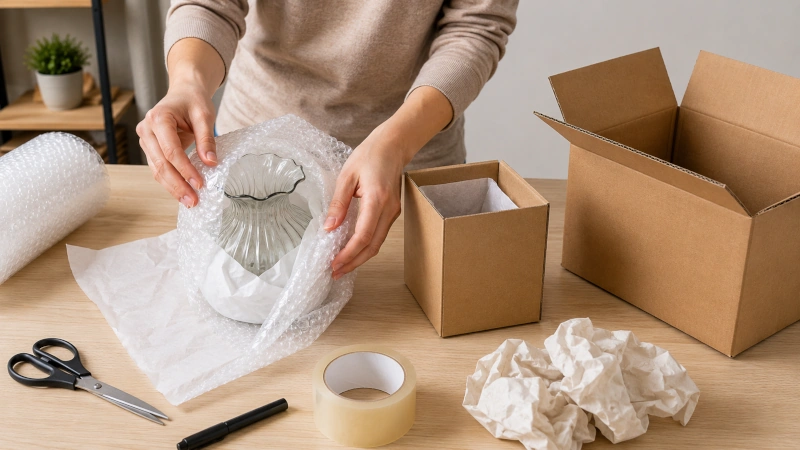
Start by wrapping the glass item individually in soft material, then build up protective layers around it. The goal here is to cushion the item itself before it ever touches the box. Bubble wrap is a standard choice, and eBay’s own shipping guidance also recommends surrounding items with protective material so there is no room for movement.
Pay extra attention to delicate points such as rims, handles, spouts, lids and stems. For sets, do not let glass pieces touch each other directly. Each piece should be protected as if it is travelling alone.
Step 2: Use a Snug Inner Box
Once the wrapped item is protected, place it in a snug rigid inner box. Australia Post’s current guidance for fragile items says glass and crockery should be wrapped individually, then placed into a snug-fitting box made of rigid material such as strong plastic or corrugated cardboard.
The inner box should not be oversized. A box that is too large encourages movement and forces you to waste cushioning just to take up dead space. Add enough filler around the wrapped item so it stays centred and does not shift when the box is gently moved. FedEx says the product should be placed in the middle of the box with ample cushioning on all sides, and Australia Post recommends extra cushioning to prevent movement inside the parcel.
Step 3: Fill Every Empty Space
Void fill matters more than many new sellers realise. Empty air is not protection. If the item can move inside the inner box, the impact forces are going straight into the glass.
UPS recommends filler materials to limit movement during shipping, and Australia Post says shredded paper, tissue paper or void filler can be used to stop items moving around in transit. FedEx also says loose-fill or other cushioning can be used to keep the product from moving around.
A useful rule is simple: when the inner box is closed, the item should feel supported, not loose. If you can feel or hear movement, reopen it and add more filler.
Step 4: Put the Inner Box Inside a Larger Outer Box
This is the heart of the double-box method. Once the inner box is packed, place it inside a larger, stronger outer box with cushioning around every side. Australia Post describes this as the “box-in-a-box” method for fragile goods. UPS says the outer box should be larger than the inner box and cushioned all around, while FedEx recommends double-boxing breakables with about 3 inches of cushioning in and around the inner box.
In practical terms, you want a protective buffer between the inner box and the outer walls. That way, if the parcel is bumped, squeezed or dropped, the outer box and cushioning take the punishment before the force reaches the glass.
Step 5: Keep the Inner Box Floating in Cushioning
The ideal setup is for the inner box to sit in the centre of the outer box with a protective layer all the way around it. FedEx recommends about 3 inches of cushioning around the smaller box, and UPS describes using cushioning to fill the gap between the two boxes as part of its two-box method.
That spacing is one of the biggest reasons double-boxing works. It gives the parcel a shock-absorbing zone. Without it, the inner box is just another hard surface pressed against the outer box, which defeats much of the purpose.
Step 6: Tape the Outer Box Properly
Once the outer box is packed and there is no remaining dead space, seal it well with strong packing tape. FedEx recommends sealing a standard corrugated box with an “H” pattern across the centre seam and edges, and UPS says to tape closures and seams to seal the parcel.
This part is easy to rush, but it matters. A well-packed item is still vulnerable if the box opens, splits or softens under strain.
Step 7: Do a Final Movement Check
Before the label goes on, give the parcel a gentle test. You are not trying to shake it hard; you are checking whether anything shifts inside. If there is movement, the item is not packed tightly enough yet.
This step follows directly from the carrier advice about restricting movement and filling empty space. If the box feels solid and quiet, you are much closer to a safe parcel.
Do Not Rely on “Fragile” Labels Alone
A lot of sellers feel better once “Fragile” is written on the parcel, but that should be treated as a backup signal, not the protective system itself. Australia Post explicitly says not to rely on writing “Fragile,” “Handle with care” or similar messages as a substitute for proper packing, because parcels can still be processed through mail bags and sorting facilities.
That is an important mindset shift. The packaging has to do the heavy lifting. Labels are secondary.
Common Mistakes That Lead to Breakage
The most common problem is too much empty space. If the item or the inner box can slide around, the glass is at risk. Another common mistake is using only one thin layer of protection and assuming the box itself will do the rest. Weak outer boxes, poor taping and allowing multiple glass items to touch each other are also frequent causes of damage.
Carrier guidance lines up closely on these points: wrap fragile items individually, keep them away from box walls, fill space to stop movement, and use a two-box method for fragile goods.
A Simple Packing Mindset That Helps
A useful way to think about fragile packing is this: pack as though the parcel will be stacked, bumped and briefly dropped, because in normal parcel networks that is exactly the kind of handling it may experience. Australia Post says parcels inevitably experience knocks and bumps during postage, which is why its guidance focuses on rigid boxes, individual wrapping and box-in-a-box protection.
That does not mean panic-packing every cheap tumbler like museum glass. It means using a repeatable standard that gives the item a fair chance of arriving in one piece.
Final Thoughts
If you sell fragile glass on eBay, your packing process is part of the product. Buyers are not only paying for the item; they are paying for it to arrive safely. A good double-boxing routine helps protect your feedback, reduce returns and make buyers more confident ordering from you again.
The basic formula is straightforward: wrap each piece individually, use a snug rigid inner box, remove movement, place that box inside a larger sturdy outer box, and surround it with cushioning so the inner box is protected on every side. That is the core idea shared by Australia Post, FedEx and UPS, and it is one of the safest habits a fragile-goods seller can build.
Leave a Reply